Your nonprofit likely has an ambitious vision for furthering its cause, and achieving your fundraising goals is an essential step in turning that vision into reality. However, time is a valuable, scarce resource when it comes to fundraising, especially when you’re chasing major gifts that require weeks or months of individualized donor cultivation to secure.
One of the best ways to ensure your team is as productive as possible is by incorporating prospect research into your fundraising plan. DonorSearch’s prospect research guide defines this term as “a technique used by nonprofit fundraisers, major gift officers, and development teams to identify high-impact donors within and beyond an organization’s current donor pool. Through this process, nonprofits gather an immense amount of data…that help[s] determine prospects’ likelihood of giving.”
Let’s discuss three specific ways that prospect research can make your organization’s fundraising efforts (particularly those that involve major giving) more efficient and effective.
1. Develop Complete Donor Profiles
Every current and potential supporter your nonprofit has made contact with should have their own profile in your donor database or constituent relationship management (CRM) system. These profiles centralize all of the information you have on each donor so you can develop a data-driven strategy for strengthening your relationship with them and securing their support.
Especially with major gift fundraising, you want your fundraising team to spend its time wisely by cultivating the prospects who are most willing and able to make large contributions to your specific campaign. Donor profiles help direct these efforts by organizing individual supporter data into actionable tidbits.
Here is a quick breakdown of the sections of a strong donor profile and some information to include in each one:
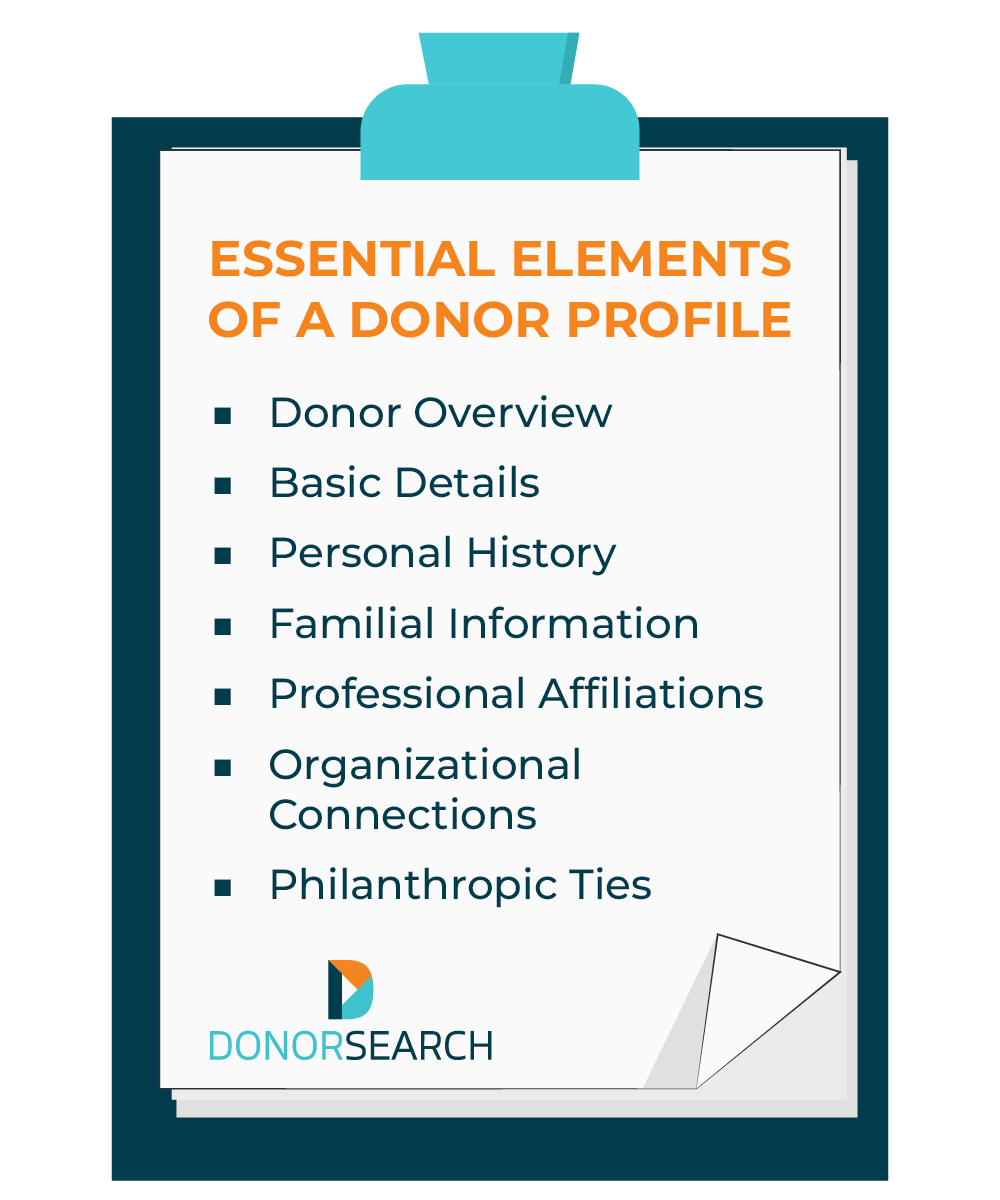
- Donor overview: The donor’s preferred name, giving status (prospect, one-time, recurring, etc.), and a summary of recent and planned next interactions
- Basic details: Contact information, date of birth, and other demographics
- Personal information: Details on the donor’s education, interests, values, community involvement, and wealth indicators (e.g., stock and real estate holdings)
- Familial information: Relevant data about the donor’s spouse, children, and other notable relatives
- Professional affiliations: Information about the donor’s current employment, career path to date, and business contacts
- Organizational connections: History of involvement with your nonprofit, including past gifts and non-donation engagement avenues (event participation, volunteering, advocacy, board service, etc.)
- Philanthropic ties: Giving to and involvement with other charitable organizations
While your interactions with supporters will provide you with plenty of information for their profiles, some details—especially those that are most indicative of a potential major donor, such as wealth markers and philanthropic ties—are only accessible via prospect research. Look for prospect research tools that integrate with your nonprofit’s CRM to ensure data transfers seamlessly between external platforms and donor profiles.
2. Enhance the Entire Donor Lifecycle
An organized prospect research strategy doesn’t just help your fundraising team identify potential major donors more quickly. Prospect research actually impacts every stage of the donor journey by providing the data you need to get and keep supporters’ attention.
In the context of the donor management lifecycle, your organization can use prospecting data for:
- Acquisition so you can reach out to potential donors via their preferred channels with messages that will resonate with them based on their complete philanthropic history.
- Cultivation by providing details you can use to establish a communication cadence, invite them to participate in activities that would interest them, and connect them with other staff and board members they might know or want to meet.
- Solicitation to determine a donation ask amount that seems reasonable to a prospect but doesn’t leave money on the table, and to suggest a gift designation that aligns with their values.
- Stewardship to choose recognition strategies that resonate with each donor and personalize thank-you messages with individual supporters’ information while still getting them sent out in a timely manner.
- Retention so you can update supporters on the impacts of their gift that they’d care most about and send other interesting, personalized messages that aren’t donation requests to prevent donor fatigue.
- Upgrade by uncovering insights into when the best time would be to ask for another contribution and how much you can reasonably request.
Revisit and reference your prospect research data regularly, and re-screen supporters throughout the donor lifecycle to ensure your information is always accurate and up-to-date.
3. Informing Large-Scale Fundraising Efforts
Although major gift solicitation occasionally happens on a one-off basis, it’s more commonly part of a larger fundraising campaign. Different campaigns will require you to learn different details about potential donors to secure their support for that particular initiative, so you should prioritize looking for specific information during prospect research
Some examples of this principle in practice include:
- Annual fundraising: While it’s common for a significant portion of your organization’s annual fund to be made up of major gifts, this revenue is meant to be unrestricted so it can support various operations at your nonprofit. So, you’ll need to identify donors who have a strong connection to your overall mission and will be happy for your organization to allocate their money wherever it’s most needed.
- Capital campaigns: For these targeted initiatives, potential major donors’ interests and values need to align closely with the campaign’s purpose (e.g., if a hospital were to conduct a capital campaign to expand its pediatric wing, the best prospects will be especially interested in improving children’s healthcare). Prospects also need to be able to give the specific amounts on the gift chart you create to guide your campaign.
- Planned giving: This area of fundraising frequently overlaps with major giving—as FreeWill’s planned giving guide explains, “Major donors contribute the largest planned gifts to nonprofits and are more likely to express interest in complex giving arrangements…However, donors at all giving levels can make valuable prospects.” This is especially true if research reveals that they have a will and a life insurance policy.
Track and analyze data on these efforts to ensure your approach gets better with every campaign you undertake. An organized prospect research strategy will help you monitor where your fundraisers are spending the most time and where that time is being rewarded with major gifts.
If your team builds relationships with the right donors, it can result in not just one-time major gifts, but sustained, impactful support for your nonprofit’s mission. Leveraging prospect research in the ways described above allows you to have the assurance that the time your team puts into donor cultivation is worth it in terms of fundraising outcomes.